

Hello and welcome back to Five Things!
So right now everyone in Germany talks about gas prizes and for the second time in just a few years, the government has to dole out heavy tax deductions to get the ga prizes down. The Iranians are holding the Western world hostage with their blockade of the Straight of Hormuz.
I really do not understand why the answer is not: “ok, understood, we’ll get out of fossile fuels as fast as possible and reduce our dependence on other countries when it comes to the supply of energy!” - and I also do not understand why people get all emotional about their furnace and combustion engine.
We have so many great engineers, so I am not the least bit worried that we can get enough solar and wind capacities going, along with an improved grid and huge batteries. We just have to learn how to think bolder again.
Enjoy these Five Things!
If America’s So Rich, How’d It Get So Sad?

American sadness this decade has been forged by the fact of, and the feeling of, a permanent unrelenting economic crisis, amplified by a uniquely negative news and media environment, and exacerbated by the rise of solitude and the declining centrality of trusted institutions. Inflation has made today’s life harder to afford, while the ambient awareness of other people’s triumphs on social media had made tomorrow’s success feel harder to achieve. The ongoing collapse of confidence in the establishment has made Americans feel unusually adrift and dissatisfied with institutions outside of their control, while the chosen self-isolation of modern life has demolished communal trust, as we increasingly experience other people’s minds through the toxic surreality of our screens rather than through the embodied reality of strangers who are, for the most part, just as nice as we are.
It’ really the paradox of our time. We have never been better off, yet we are not as happy as we should be. In Europe, the Fins and the Danes are the most happy people and in Germany it’s the people living in Northern Germany, right adjacent to Denmark, who are the most happy people. It’s probably the wind and the open sea around here. Or the rain.
Muskism as Fordism
Musk and his colleagues have the good fortune of living in a moment when there is no structural actor capable of challenging their dominance. The working class has virtually ceased to exist as an organized force. Absent pressure from below, political parties themselves offer no meaningful opposition to Muskism. The effect is paradoxical. On the one hand, the lives of capitalists are made easier when they can intensify the exploitation of their workers and purchase influence in politics with little resistance. But it also means they have no incentive to restrain their most antisocial impulses or consider the long-term consequences of their actions.
Muskism typifies this tendency: if Fordism and post-Fordism were both, in different ways, organized to secure social peace, Muskism is oriented toward social war. The relative thinness of the Muskist mode of regulation is symptomatic: the working-class antagonist is so weak, the social war so asymmetric, that there is no need for a negotiated peace. At the moment, the strategy seems to be working. Musk, already the world’s richest man, is projected to become the first trillionaire as soon as next year.
I’ve said it before: we need better regulation. We are too slow to understand what’s going on and then we don’t regulate as tough as we should.
Creating Baby Geniuses to Thwart the AI Threat? (Yes, Really.)

Investors follow the money, of course, but part of the dual appeal of genetic optimization and AI is that both are central to transhumanism. This futurist philosophy, popular among the tech elite, aims to marry advancements in biology and technology to accomplish things today’s humans cannot—like extending our lives (perhaps forever!) or circumventing climate change (by colonizing other planets). While it may seem odd that these billionaires are constructing one technology some of them admit could bring about human extinction, even as they back another one to save us from what they’re building, there is, in fact, a unifying theme: “the rejection of limitation,” explains Alexander Thomas, author of The Politics and Ethics of Transhumanism. “That colonial impulse of ‘I want more.’”
I’m all for techno-optimism, but I opt out of transhumanism.
Into the Right-Wing Dreamworld
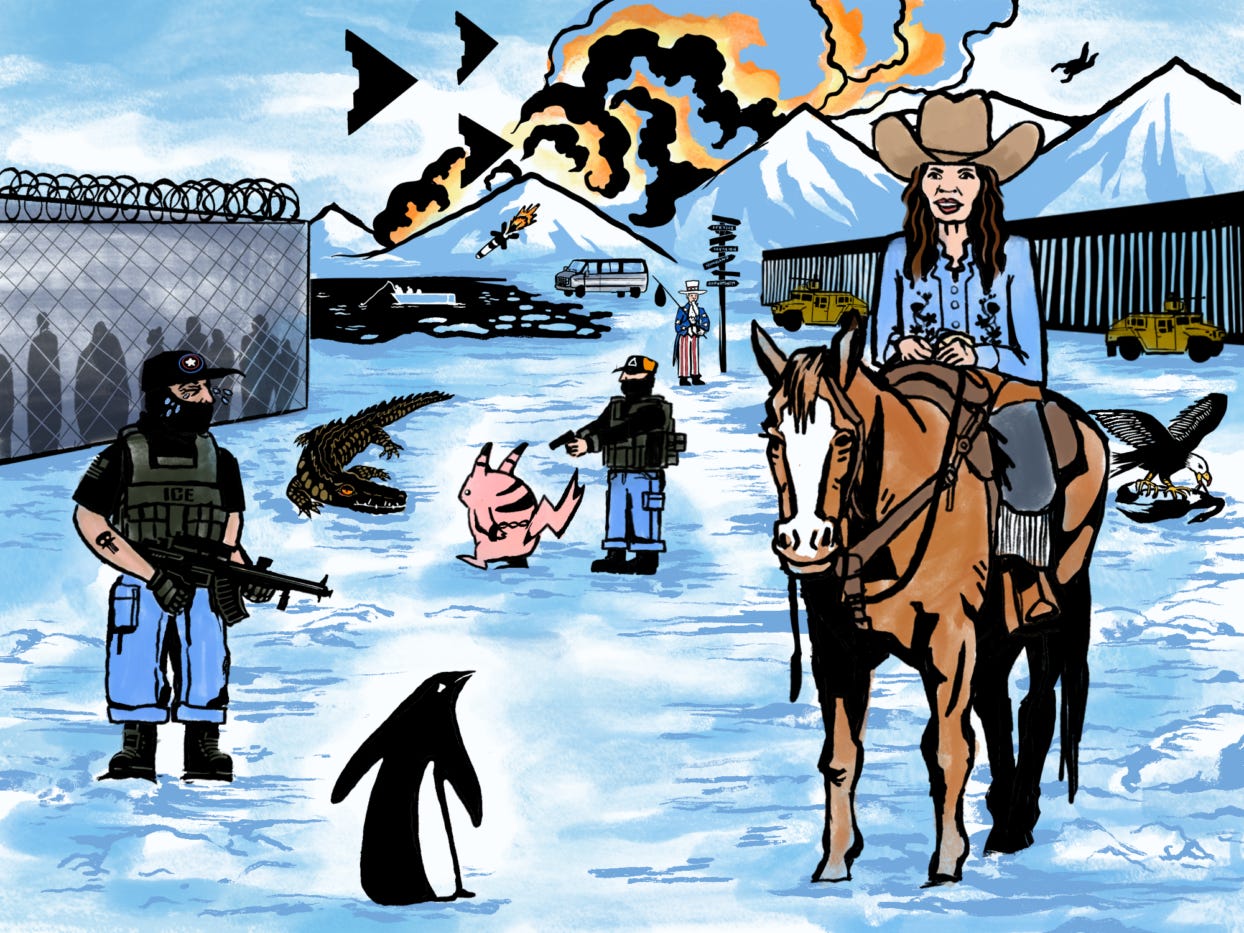
If the first Trump administration was a regime of words — the years of presidential tweets and unfiltered musings; of covfefe, grab ’em by the pussy, not sending their best — the second is a regime of images. Of course there were totemic visuals in those earlier years: tiki-torch-wielding neo-Nazis, gas-masked cops streaming out of burning precincts, face-painted hordes descending on the Capitol. (Crowds and fire were notable motifs.) But for the most part, the novelty of the first administration’s political style lay in its desublimation of speech. How could he say that, liberals were always asking. Today’s unofficial MAGA slogan, in contrast, is You can just do things — that is, the government can flood the streets with murderous federal cops, or start a war with Iran without waiting for Congressional approval, let alone making any real effort to manufacture the public’s consent. Funnily enough, this change mirrors a reverse development, a shift from an administration of professional doers to one of professional talkers: from career bureaucrats like Steven Mnuchin and Jim Mattis to the posse of podcasters, news anchors, and health influencers who stalk the halls of government today.
It’s weird. And here in Germany the far right is trying to instrumentalize the fate of a stranded wale, pushing the image of the wale as the symbol for a government that is not trying to help its people. It’s all beyond bizarre and takes me back to the article about happiness. We have lived in comparatively peaceful times with lots of prosperity, still people believe right-wing idiots who want to exploit them.
The Disappearance of the Public Bench

It might be true that benches can’t create community, but they can support the interactions that do. They give the elderly the ability to navigate their neighborhoods, providing opportunities for cross-generational interaction. Noisy phone calls and messy to-go meals that might otherwise be taken indoors are instead indulged in public, creating minor vexations but bringing people — and watchful eyes — to streets that have been scarred by violence. Despite all they’re up against, the Bronx benches are an invitation to share a space and build a public culture on what was formerly a patch of cobblestones.
A couple of years ago they started putting up benches in my neighborhood at a few streetcorners. One bench, right next to the subway station, disappeared right away and I assume that happened because people sat on it and drank and smoked. All the other benches stayed and I find it delightful to see people there, young and old, just sitting there, enjoying the day.
That’s it. Have a great Sunday! If you missed last Sunday’s edition of Five Things, have a look here:

— Nico
Happiness is looking out on the ocean and counting waves… sun or rain doesn’t matter…