

Hello and welcome back to Five Things!
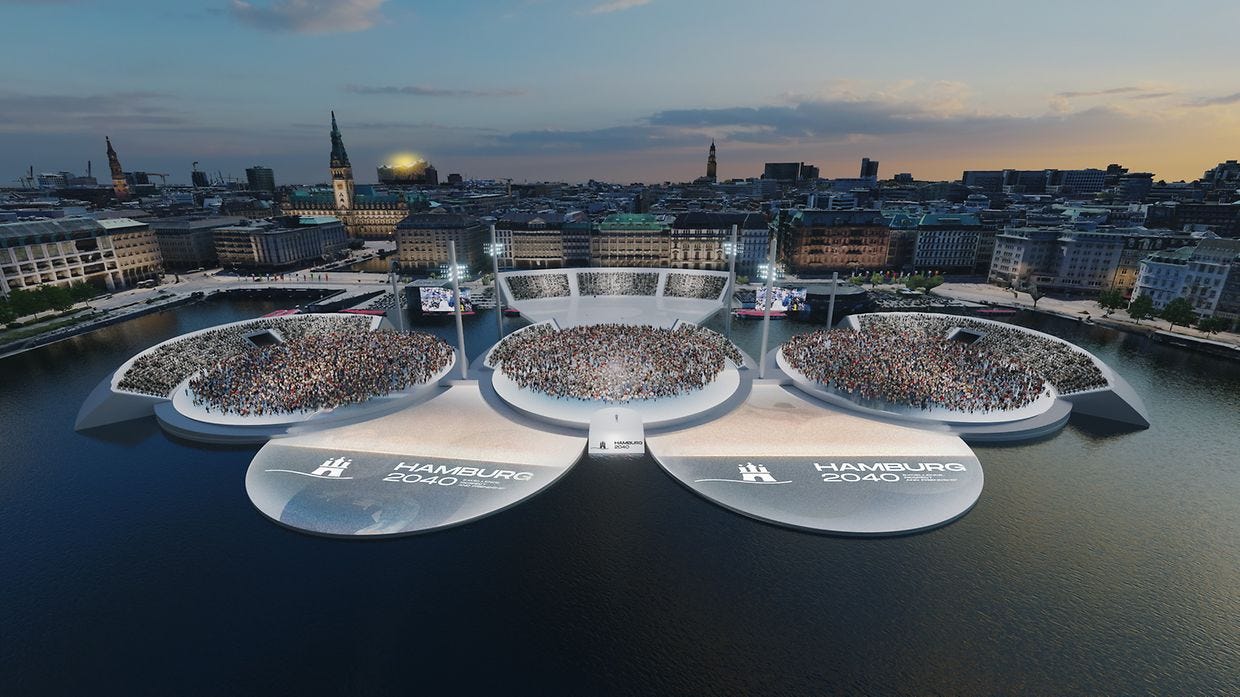
I spent Friday evening watching the opening ceremony of the Olympic Winter Games in Italy. While I am not terribly interested in winter sports, I do like it when the world comes together to celebrate. I am a big fan of the olympic idea and I do know that it all has been heavily commercialized. Currently, my hometown Hamburg is campaigning for getting to host the summer Olympics in 2040 and while I do know that traffic will be annoying for a few weeks in 14 years or so, I think this will be one amazing chance to show the world how great Hamburg is. I am all for it!
Also, the snow in Hamburg is gone and now we are back to the other side of winter: rain at 2° celsius, which is just aweful. I cannot wait for spring, when the rain gets warmer…
Enjoy these Five Things! 🕺
This Is Just Who Trump Is

The best way to understand the president’s motivations is to find him at his most unfiltered, which is to say, on social media, late at night. And Thursday night, Trump posted a video to his Truth Social account that depicted President Barack Obama and Michelle Obama as apes. The clip, which runs for roughly a minute and shows the Obamas at the end, is set to “The Lion Sleeps Tonight.”
I try to avoid superlatives in my writing, but there is simply no question that this is the most flagrant display of presidential racism since Woodrow Wilson screened D.W. Griffith’s “The Birth of a Nation” in the White House in 1915. And for a sense of the racism of Griffith’s film, recall that it both reinvigorated the Ku Klux Klan and gave the organization its modern iconography.
Trump is a narcisist, a fascist, a racist, but most of all he is ruining the country that I love so much.
Technocracy 2.0

There has never before been such a close association between tech capital and the American state. Previously less MAGA-friendly, tech industry leaders have virtually all turned toward Trump since his 2024 victory, eager to gain favors and position themselves as kingmakers in the market. In the global race for AI dominance, the Trump administration views Silicon Valley as an extension of itself, from Palantir working openly with the US military for surveillance and defense systems to OpenAI seeking government aid guarantees on its debt.
Buoyed by previously unthinkable stock valuations, tech capital and political power have formed a symbiotic relationship. It is an arrangement that has been in the works for some time.
I have been saying this for a while, but we really, really need to regulate tech much more and much better - these people should never ever have gotten so much power and influence.
AI and the End of Common Culture

Many essays have analysed and attempted to explain the fragmentation of culture, and these explanations point to things like the primacy of individualism and the rise of identity politics. The main culprit, however, is probably technology. When the costs of producing and distributing content are high, it is only worth producing content that appeals to a mass audience. When technology reduces those costs, creators can serve niches. You’ll only green-light the production of a high-budget movie if you hope to attract millions to the cinema, but you’ll be happy to produce a TikTok video if it can reach a hundred people. You’ll need, say, a million clients to break even with software that costs ten million dollars to develop, but with costs reduced tenfold, you can address a user base ten times narrower. You’ll have no incentive to appeal to the long tail of music amateurs if distributing a soundtrack implies costly physical manufacturing, but once it becomes possible to upload a song to Spotify, you can earn a living by satisfying a micro-audience craving a micro-genre.
In other words, when creation is expensive, it is scarce and audiences converge on the few things that do exist. Common culture emerges. As creation becomes cheaper, audiences fragment. Now what if creation wasn’t cheap, but free? With AI, creation does become free. Now, for content to be worth producing, it only needs to appeal to one person. AI gives us cultural niches of one. Culture is fragmented; it is about to become atomised.
This is a huge paradigm shift. Just think about it. And yes, I am typing this right now. But just imagine the endless possibilities, good and bad.
Losing self and finding sanctuary under Montana’s night sky.

In nighttime, however, darkness made infinite detail invisible and left only the outlines of each earthstack evident against the horizon. Because the State of Montana manages this place as a primitive park, its rock gardens are motorless and unlit. No RV generators. No latrine lampposts. All sounds were plant and animal, including the noise of our bodies moving through silence: lungs drawing air, feet crunching gravel.
Even these sounds subsided as we lay down in the grassy center of a cul-de-sac at the trailhead. One light source remained in camp, about 150 yards away. A solar lantern we’d set on a picnic table threw light against ponderosa trunks and into their needled canopy. From our vantage point, this cool blue essence hovered within the dark copse like a biosphere on a hostile planet.
Wonderful.
The pie and mash crisis: can the original fast food be saved?

The pie and mash shop is itself a product of relentless innovation. It sprung up as an alternative to the street pie man, providing four walls and a roof where working people could eat. It switched from eel pie to mince when the economics demanded it. But once pie shops came to be seen as endangered, tradition became the point, and innovation a drawback. Shouldn’t they be able to mutate in order to survive?
I know that the food on the plates does not look too appealing for some of you, but there is a thing that has been bothering me about food for quite a while now. I can get whatever cuisine I want, but good old food I grew up on is hard to find these days. No, I didn’t grow up on pie and mash, but lots of Northern German dishes are hard to find anywhere, but burgers are everywhere, as is döner or pizza. On a quasi-related side-note: my wife just made a wonderful lentil stew which tasted just like it was supposed to. Maybe I am having a nostalgic minute right now…
That’s it. Have a great Sunday! If you missed last Sunday’s edition of Five Things, have a look here:

— Nico