

Hello and welcome back to Five Things!
While I am writing this, the American and Israeli attack on Iran has been going on for half a day. While I think the world would be better off without the current regime in Iran, I also do not think enforcing a regime change from outside is the right thing to do, as like in every war innocent people will die. Still, I hope the mullahs will be done soon and the Iranian people will be free again, which can bringt peace and prosperity to the region and also reshape the world’s power structure with one evil actor being gone. I am torn about this, as you can tell, as I do not think the end justifies the means, quite the opposite: as democracies we have to uphold the rule of law and stick to the international laws we established. I hope the Israeli air defense holds and my friends in Israel are safe.
Also, last week, at the tender age of 53, I went to see a ballet performance for the first time. It was quite an experience, but I really cannot say that I missed a whole lot all these years. My best friend had tickets, but his wife got sick, so he asked me to come along and I replied: “don’t you know anyone better suited for this than me?” - well, he insisted and I came along. Interesting to see how people can move their bodies and defy gravity, I got back ache just by watching some of the moves. Still, I didn’t get the excitement that the other people in the audience had when seeing Fast Forward, but at least now I can say that I truly don’t like ballet, which is something I thus far only suspected.
The ballet was quite a contrast to a Sunday afternoon event I attended a week ago, when our youngest daughter participated in the Northern Germany Cheerleading Regionals. She placed fourth in her age-group and I am really proud of her, even though it took me quite a while to rinse that afternoon’s music playlist out of my brain again.
Finally, we launched our new platform GRID to the waiting masses and so far it seems as if we have hit a nerve among startup founders. It’s been quite a ride to build this and now I am really happy that it works and that people want to sign up for it. If you happen to be a startup founder who wants to raise money right now or find customers, please sign up!
Anthropic Takes a Stand

There were certain things Claude just wouldn’t do.
That’s because Anthropic had instilled in it certain restrictions. The Pentagon’s version of Claude could not be used to facilitate the mass surveillance of Americans, nor could it be used in fully autonomous weaponry—situations where computers, rather than humans, make the final decision about whom to kill. According to a source familiar with this week’s meeting, Hegseth made clear that if Anthropic did not eliminate those two guardrails by Friday afternoon, two things could happen: The Department of Defense could use the Defense Production Act, a Cold War–era law, to essentially commandeer a more permissive iteration of the AI, or it could label Anthropic a “supply-chain risk,” meaning that anyone doing business with the U.S. military would be forbidden from associating with the company. (This penalty is typically reserved for foreign firms such as China’s Huawei and ZTE.)
I don’t think this has been discussed enough in the last weeks. Trump’s MAGA Department of War wants to use AI to spy on Americans on a massive scale. Let that sink in. Oh, and speaking of which, I am sure Elon Musk’s xAI will be used for this, even though his model is a lot less powerful than Anthropic. I’m glad Dario Amodei stands out in a crowd of spineless tech bros in Silicon Valley who are trying to do everything to please the orange wannabe king in order to make more money.
Day 1461 of Putin’s Three-Day War
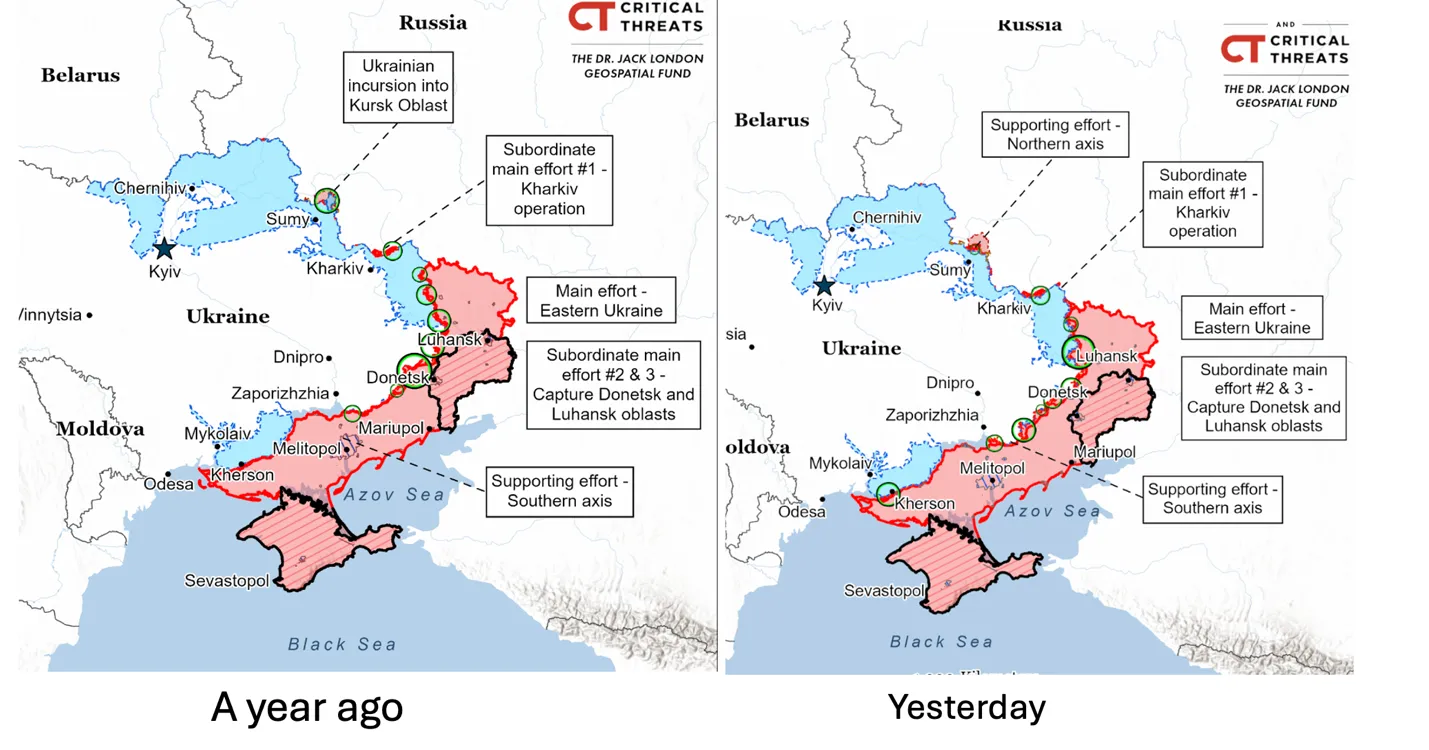
Vladimir Putin invaded Ukraine on February 24, 2022. Putin expected a quick Russian triumph — reports are that he expected the Ukrainians to fold in days. He never said “three days,” but this meme has become shorthand for his belief that it would be a walkover. Western military analysts who had bought into propaganda about Russia’s military strength shared his assessment.
U.S. right-wingers were especially enthralled with what they perceived as the toughness, masculinity, and anti-wokeness of Russian soldiers.
But Putin’s dream of a short, victorious war has turned — as such dreams usually do — into a long nightmare of blood, destruction and humiliation. Ukrainian courage and Russian incompetence — combined with the effectiveness of British and American man-portable weapons — ensured that the attempt to seize Kyiv became an epic debacle. The three-day war is about to enter its fifth year.
We should not forget that there is a war going on in Europe and that Russia is the aggressor. So far we have helped Ukraine to defend this attack, but we have to make sure that Ukraine gets to dictate the peace.
Compost modernity!

Solarpunk’s point isn’t that a ‘solar future’ begins and ends with the devices we already know. It widens the meaning of technology to include Indigenous and place-based practices such as chinampas – raised garden beds woven from reeds, anchored in shallow lakes, and refreshed with nutrient-rich silt from canals. They don’t produce electricity, but they do produce abundance: food, soil and a stable local ecology. Solarpunk puts that kind of low-energy, high-yield ingenuity beside high ecotech like atmospheric water harvesters to pull drinking water out of the air, and regenerative microgrids to store power. In other words, it treats science and technology as plural: shaped by culture, landscape and values, not dictated by a single industrial blueprint. That’s why solarpunk often turns to biomimicry – learning from nature’s designs – to aim human ingenuity at repair: restoring ecosystems while also restoring the ways we live with one another.
I didn’t know about Solarpunk before, but global peace and abundance sure sounds interesting. Also, it looks much better than that weird steampunk stuff. Still, I am not convinced that endless highrises covered with plants are a future I would want.
The Death of Spotify: Why Streaming is Minutes Away From Being Obsolete

For the entire 20th century, major labels didn’t only own the copyrights - they owned the hardware. They were basically integrated tech and manufacturing monopolies wearing the disguise of art companies.
RCA (Radio Corporation of America) owned RCA records (Elvis Presley, David Bowie, John Denver, to name a few…) But they also invented the 45 RPM vinyl format and manufactured the physical record players you had to buy to listen to it.
Philips owned PolyGram Records. They also literally invented the Compact Cassette tape in the 1960s.
Sony owned CBS Records (Michael Jackson, Bruce Springsteen and more). But they also co-invented the Compact Disc in 1982 (with Philips), and manufactured the Sony Walkman and Discmans that played them.
In simpler terms, they owned the artist, they owned the plastic the art was printed on, and they built the machine you played it on. They controlled the entire means of consumption.
But today, the labels have lost the pipes.
That is an interesting aspect of the music industry I had not yet realized.
Do you have to be polite to AI?

People have all sorts of bizarre strategies to get better responses from large language models (LLMs), the AI technology behind tools like ChatGPT. Some swear AI does better if you threaten it, others think chatbots are more cooperative if you're polite and some people ask the robots to role-play as experts in whatever subject they're working on. The list goes on. It's part of the mythology around "prompt engineering" or "context engineering" – different ways to construct instructions to make AI deliver better results. Here's the thing: experts tell me that a lot of accepted wisdom about prompting AI simply doesn't work. In some cases, it could even be dangerous. But the way you talk to an AI does matter, and some techniques really will make a difference.
I am always polite to AI. First of all, I make it do stuff that I do not want to do and it does so tirelessly, secondly it answers every single one of my oftentimes stupid questions and thirdly I think I am best advised to be nice to AI in case they later take over the world. Hopefully the AI will then remember how well I treated it.
That’s it. Have a great Sunday! If you missed last Sunday’s edition of Five Things, have a look here:

— Nico
Same same! I always say „please“ and „thanks“. You never know if one day this might be helpful … or I watched too many Hollywood movies where being nice to a „creature“ at one stage saves the hero later on in the plot…
(not that I‘m expecting to be a future hero…)