

Hello and welcome back to Five Things!
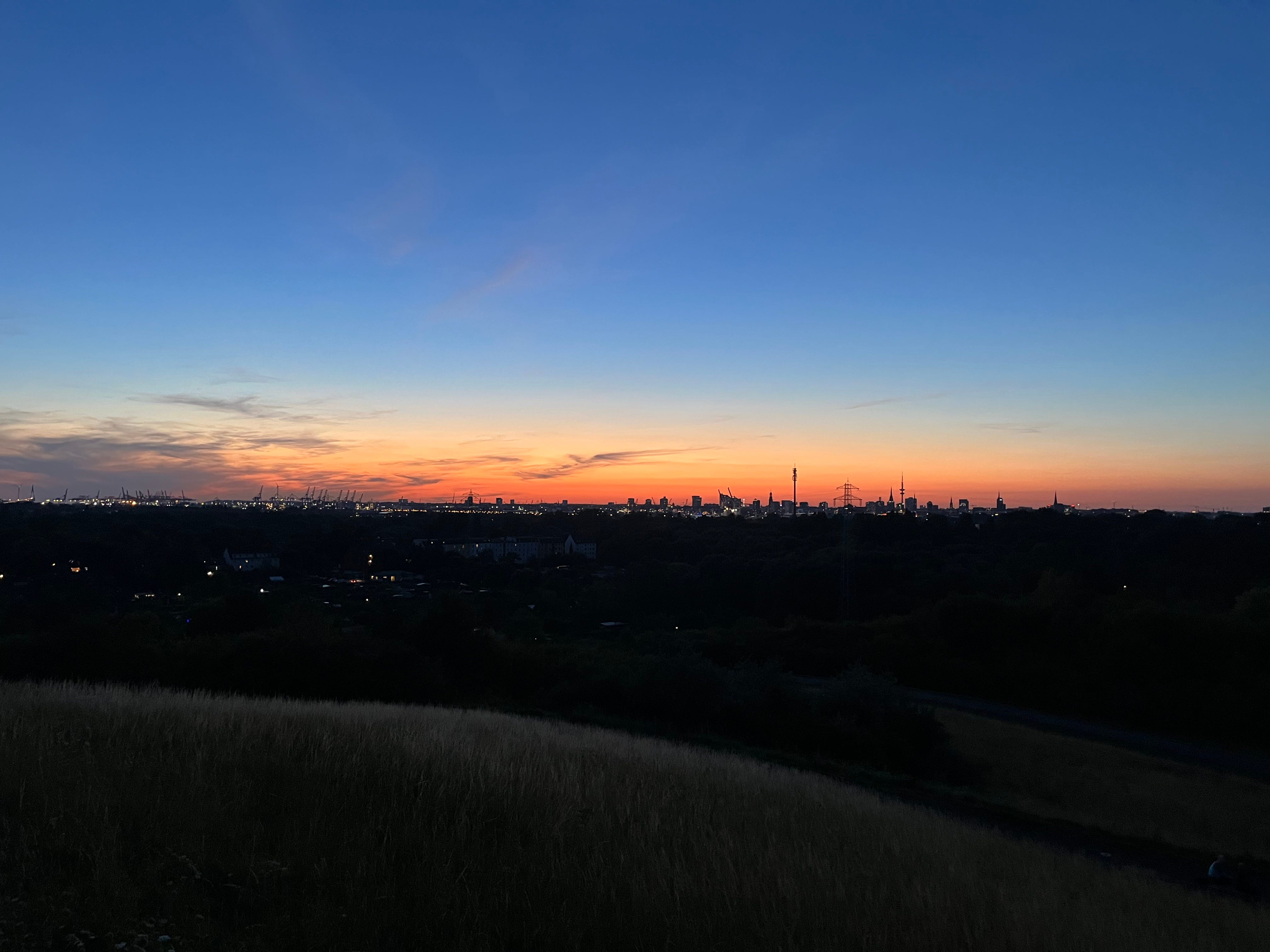
We went up on the so called “Energieberg” in Hamburg last evening. The “energy mountain” is actually an old toxic landfill that some clever people turned into a green hill just a bit outside of the city of Hamburg. We went to see the sun set across the port and we wanted to see shooting stars. I am probably not patient enough to see shooting stars, but I sure enjoyed the views of the city. As usual, I explained a lot to my kids, and as always I make stuff up and totally exegarrate when the real topic is a bit too boring. So my youngest daughter looked at me and sad: “for real or are you bullshitting me again?” - now I sure hope that those flashing red lights on top of large structures like wind turbines or chimneys are really there to alert pilots. How am I always supposed to know everything, I am just the father! Unfortunately, my kids found out a few years ago that it mostly was not true when they asked me for help with their homework and I told them I couldn’t really help them as the topic was not yet invented when I was in school. I blame the internet, kids are too smart these days.
Why Is Everyone In Tech So Sad?

Knowledge work has always been inherently abstract. Plenty of these jobs, particularly at larger organizations, are structured like Russian nesting dolls: roles designed to support other roles, which support still other roles, layer after layer, until it’s no longer clear where there’s a solid center to be found. It’s easy to see how, to a plumber, a carpenter or a line cook, work of this nature can appear like exactly what David Graeber called it: bullshit.
Knowledge work’s one saving grace, until recently, was that it was still executed by humans. We were needed. It was flesh-and-blood humans who sat down to work through a challenge, built the slide deck, wrote the customer response and developed the strategy. Even if it was existentially meaningless, there was human thought, collaborative work and creativity poured into that work, giving it life.
Digital Transformation is eating its children, so to speak. It’s easy to talk about change, but a lot harder to experience it yourself.
Why Is Europe Burning?

Already this year, more than two hundred thousand hectares have burned in Spain, a figure that is twice than the historical average. France is dealing with a similarly extraordinary fire season. A conflagration west of Bordeaux, described as four times the size of Paris, prompted the largest peacetime evacuation in the country’s history: two hundred and twenty thousand people. Meanwhile, English firefighters have struggled to contain the Tintwistle Moor fire, which is thought to be one of the largest in the country’s recent history. Even as meteorologists warned that a “monstrous, long-lasting” heat wave—Europe’s fourth of the year—was approaching, other fires burned as far north as Sweden and as far south as Crete.
People are still talking about the weather, but it is the climate that is changing and we can all see it. And monocultures are great for the industrial agricultural sector to exploit the land, but it is a really bad idea when the land is too dry and fires break out.
The Attack We Knew Was Coming

The strategic evolution of cyber operations reflects a broader truth about contemporary conflict: Adversaries no longer need to destroy a nation’s military to impose real strategic costs; they can instead undermine the systems upon which civil society itself depends. On the face of it, a water-treatment facility may appear to have little connection to national defense until one considers the cascading consequences of disabling it. Hospitals rely upon clean water. Fire departments rely upon water (and water pressure). Manufacturing plants depend upon reliable municipal systems. Citizens expect government to provide potable water every day without interruption. Even a temporary disruption to that confidence forces governments to divert resources, commands attention at the highest political levels, and reminds the public that essential services are more fragile than they are believed to be. The strategic objective is often less about physical destruction than about eroding confidence and trust in government and its institutions. A cyber attack that causes the public to question its drinking water, for example, becomes psychological as much as operational.
What I find surprising about cyberwarfare is the fact that people are still surprised this is actually happening. It has been going on for decades, but it was still easy to ignore. That has changed.
The Surprising Benefits of Small Talk

Sometimes if you have something on your mind it can be surprisingly helpful to talk to someone you don’t know. They can be more objective. You don’t have to manage their emotions. And they can see things in a different way than you do.
Small talk is fun. You get a window into another person’s life.
And it doesn’t just benefit us. It benefits society because it changes how we see other people and the world. Research shows that it makes us more trusting and increases our perception that other people and the world are kind and good.
I’m really not good at small talk. Sure, I can talk about the weather or football any time, but most of the time I’d rather not. I dread those “did you get here alright?” questions that imply that it did more than drive and park to get somewhere, some adventure of sorts. Sometimes even I am in a chatty mood and then my wife is all irritated that I actually chatted with a stranger for no reason at all. Apparently, I should do it more often and then the world will be a better place. How was your coffee this morning? Fine weather today, huh?
French bulldog dethrones ‘The Dream Team’ at World Dog Surfing Championships

Drottar and his 5-year-old yellow Labrador, Rosie, paddled out on Saturday as one of the circuit’s marquee teams. Toting an orange, honeycomb-textured chew toy, Rosie walked down to Linda Mar with 338,000 Instagram followers and a résumé that made her one of the sport’s biggest stars. Her likeness appeared on T-shirts and hats throughout the crowd, and two women had flown in from Los Angeles just to watch her take to the water.
Rosie lived up to the billing, winning the large division, dog-human tandem and stand-up paddleboard competitions before adding the Spirit of Surfing Award, presented by Rep. Sam Liccardo, to an already overflowing collection of hardware. “She just knows how to move,” Drottar told SFGATE in a phone call ahead of the competition. To him, Rosie’s talent has always seemed more instinct than instruction.
“She’s part of the ocean when she’s out there,” he said.
Ok, I admit it. I had never heard of the World Dog Surfing Championships before. I am not sure our dog would ne into surfing, but she does like the water. I guess I need to put her on a board the next time we’re at the coast! Here’s more windsurfing or kite-surfing territory, which could be a bit tricky as the paws don’t have thumbs…
That’s it. Have a great Sunday! If you missed last Sunday’s edition of Five Things, have a look here:

— Nico
In this case (the red lights), no bullshitting!
And if you want to do some extra „Klugscheissen“: Since July 2020 these lights should be (unless they are in a regular flight path) not permanent but on-demand… at least on windmills…
https://www.spie-wind.com/en/services/aviation-aid-systems/
So technically those permanently blinking ones in the country side are not following the rules anymore…