
Good Morning! 🏃🏻♂️
This week I put together a bunch of articles about taking baking soda before a run, running backyard ultras until you cannot run anymore, running the Pennine Way in under three day, how running changes when you age, and why I from now on can justify eating blueberries all the time, even when I am not running.
Every Sunday when I sit down to write this newsletter I get reminded again and again how amazing running is, in all its aspects.
Read on, my dear. And then go running! 🏃🏻♂️
Why All the Runners Are Eating Baking Soda Now

Bicarb is just a fancy new term for what most of us know as baking soda (a.k.a. the orange box you leave in the back of your fridge to keep it from smelling). But the white powder is more versatile than you might realize: As an antacid, it can relieve heartburn, and in hospital settings, it’s used to buffer anesthetics and reduce pain. Perhaps most surprising of all is its effect on exercise performance. Studies on consuming bicarb for its athletic benefits date back to the 1930s. Its use has been investigated in running, cycling, martial arts, soccer, rugby, hockey, basketball, rowing, and swimming —mostly showing gains in events ranging from 45 seconds to 10 minutes. Research indicates that it can improve performance during short-term high-intensity exercise and delay the onset of exhaustion. In 2021, the International Society of Sports Nutrition went so far as to make a statement based on a “comprehensive review of the literature” that bicarb “improves performance in single- and multiple-bout exercise” for both men and women.
Bicarb is getting mainstream, but would you use it? I cannot stand most gels and I assume bicarb must taste revolting at best.
In Backyard Ultramarathons, the Race Goes On Until Everyone Gives Up

Most runners employ a version of the run-walk method, combining jogging with walk breaks, but the exact pace is a personal preference. Some competitors aim to expend as little energy as possible and use almost the full hour on the course. Others will move a little faster in exchange for more time in their chair or a few minutes of sleep.
Between “yards,” as each 4.167-mile loop is known, competitors fight to keep their bodies functioning. They drink the latest high-carbohydrate sports drinks and eat comfort food like instant mashed potatoes and ramen. (Mr. Dailey’s 12-year-old daughter, Kaelynn, who covered 41.6 miles, fueled herself in part with Nerds Gummy Clusters.) They stretch and massage themselves, and try to discern if that sharp ankle pain is simply a blister or something more concerning.
A friend told me a few days ago that apparently Backyard Triathlons are now a thing. I am not really good at endless repetition, but I still think a Backyard Ultra would be fun to run.
Endurance running makes you become like an animal, it is so raw
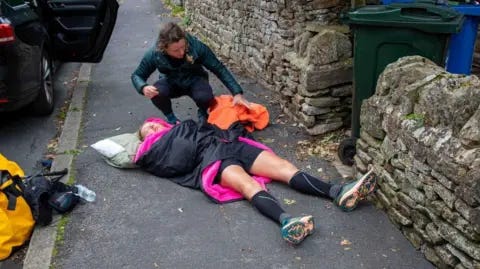
And pushing herself so hard means handling extreme conditions and emotions.
“The tough parts are super tough,” Gossage said. “There’s a voice message that I left on the WhatsApp group on the final day when I was desperate for water and I was just crying and crying and I was in a hole.
“But those lows are part of what draws you in because you always find a way to get through them and then you get the high afterwards.
“You’ve got to be really excited by it and doing it because you really want to not because of some arbitrary record or other.”
Running the Pennine Way in less than 3 days is an amazing accomplishment. And I know that without ever having come close to running 422 kilometers.
My Adolescent Stride

My personal peak occurred in 7th grade. Curling at full speed off the curve of a 200-meter race, I never felt more powerful and free. Sure, I got faster, and yes, I placed higher. But that 2nd-place finish in the boys’ 200-meter race was as an intensely satisfying moment of flight as I have ever experienced. Eyes closed, I can picture the blurry expression of my peers looking on, mouths agape as my arms pumped, knees drove, and I shot to the finish with force.
The relative enjoyment of all my other running successes has revealed a surprising truth: it never got better than that spring day in 7th grade. Yes, the satisfaction of victories, personal bests, and marathons run expanded in complexity and sacrifice, but each at its peak was only equal to that 200-meter sprint.
That’s the cool thing about running. It changes. And it changes you. I still remember some runs I did 40 years ago and I love to see it when my kids go running together.
Research Suggests That Eating Blueberries Can Make You Faster. Here’s What I Learned From a Week of “Berry-Doping”

The study involved nine trail runners, two time trials, a battery of pre- and post-race physiological tests, and quite a few blueberries. And the results were pretty clear: Participants saw overall improvements in their running performance and several physiological measures—including resting heart rate and perceived tiredness—when they followed a blueberry-loading protocol in the week immediately before a race.
As a blueberry-loving runner, I eagerly accepted these findings—but not without a little skepticism. Could simply eating blueberries really make you faster? And even if it could, it would have to be a truckload of them, right? I decided to test the research myself.
For more than a week, I tried berry-doping on my own to see if I’d experience similar results. To match the study’s methods exactly, I’d have to down a lot of fruit … but it’d be worth it for a berry-fueled PR.
I love blueberries and I am just putting this article in here to justify eating more blueberries because of science.
If you missed last week’s edition, you can read it here:

Now, go running!
— Nico
🏃🏻♂️