
Good Morning! 🏃🏻♂️
A crazy thing happened to me last week: I went running. Twice. And pain-free.
Amazing. I think I will do that again. And hopefully even longer than just a few kilometers.
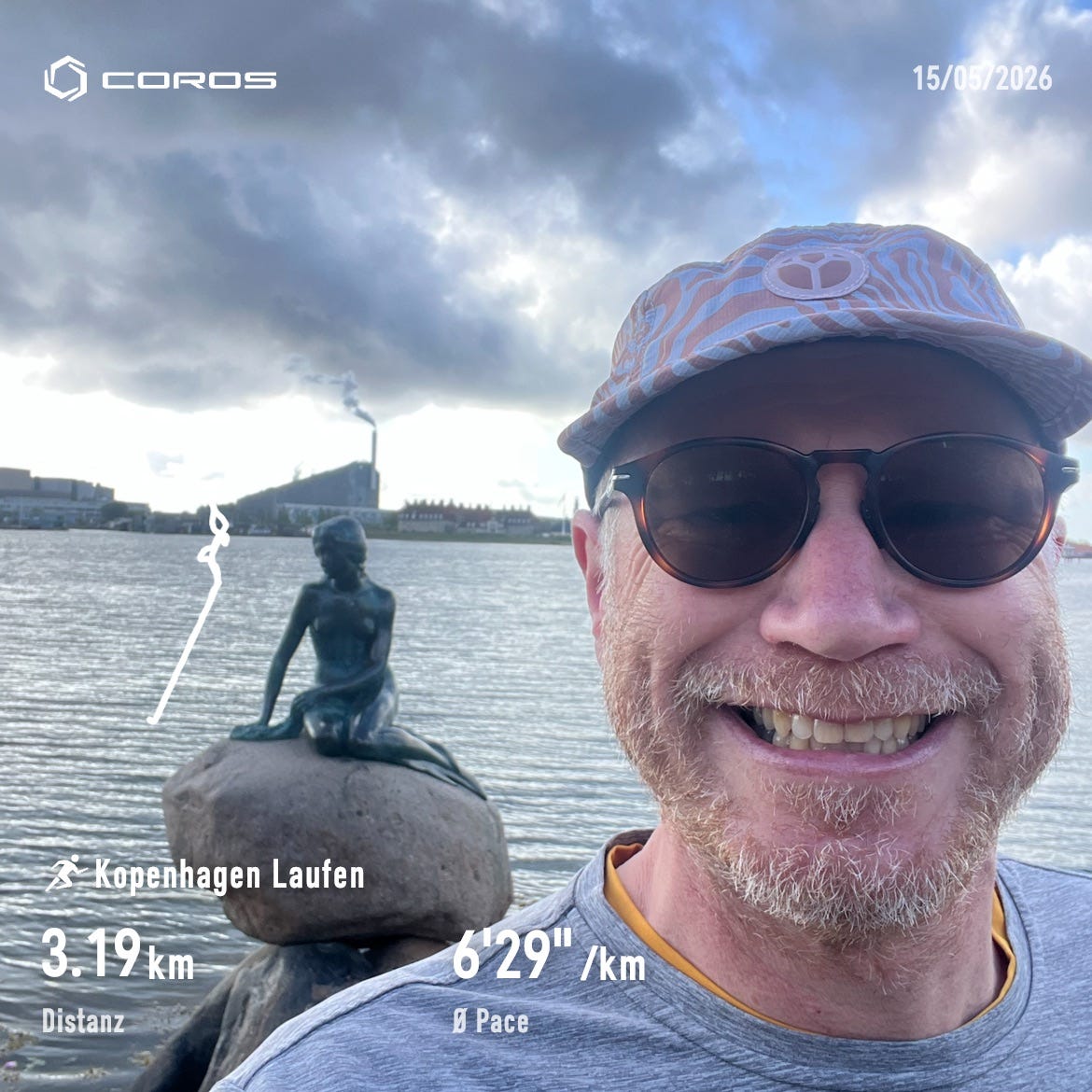
Also, the second run took place in Copenhagen, which is such an awesome city to run through. I just love running along the harbor to the little mermaid early in the morning. Of course, fashion-conscious that I am, I ran in my Saysky shorts and totally felt like a local without fear of cultural appropriation. In the back of the photo you can see Copen Hill and there is some unfinished business: I wanted to run up Copen Hill on my trip to Copenhagen in December and it was closed, so I guess I have to get in shape and come back for it. Also for the hot dogs with rød pølse.
Enjoy these Five Things Running! 🏃🏻♂️
Sawe’s secret sauce: inside the lab that fuelled historic sub-two hour marathon

When Sawe last month in London became the first person to run an official marathon in under two hours, much of the coverage focused on the Kenyan’s carbon-plated shoes. But here, on the west coast of Sweden, a team of scientists, nutritionists and technicians believe another factor was just as significant, if not more so.
“We don’t have the megaphone that the shoe industry has,” says Olof Sköld, co-founder and chief executive of the sports nutrition brand Maurten. “We are not that visible. But if you talk to the athletes and coaches, the elite world knows who we are.”
A glance at the feet on major marathon podiums reveals an array of brands from Adidas and Nike to Asics and On. Where shoe brands differ, there is only one constant among the very best runners: since 2018, every men’s and women’s marathon world record has been run by an athlete using Maurten nutrition products. Sawe’s extraordinary London Marathon time of 1hr 59min 30sec was the latest.
And I always thought people would use Maurten because of all the wonderful flavors it offers.
‘It Just Wasn’t Fun Anymore’: Why Molly Seidel Stepped Away from Marathoning—and Is Thriving on the Trails

“It just wasn’t fun anymore,” she said. “It’s really hard to maintain that level in marathoning. It’s a steep peak that you have to remain on top of. I needed a change. I needed something different.”
With three strong ultra-distance races under her belt already in 2026, her foray into the competitive trail running scene has gone better than expected. She has already earned a place in the June 27 Western States 100—the most prominent trail race in the U.S.—where she humbly hopes to compete for a top-10 finish.
That is exactly why I am not running marathons anymore. All kidding aside, I can totally understand her reasoning.
Western States is Not Just a Race

It might seem dry, but public filings are often where you can learn the most about what’s going on inside an organization that won’t necessarily make it into a press release. So what do the numbers tell us about what the WSER Foundation, and the race itself, have been up to or where they’re going?
Most people think of Western States as an iconic, point-to-point, 100-mile foot race from Lake Tahoe to Auburn, California. Many people also know the WSER Foundation as the organization that manages and puts on Western States. Which it is, but that’s not all it is.
This is a really interesting write-up of the budget behind the oldest 100-mile race in the world.
Yes, You Can Run That Slow

So what’s really going on when runners complain of discomfort at paces slower than their normal easy pace? I’ve come to the conclusion that it’s an example of somatization, or “the unconscious process of converting mental, emotional, or psychological distress into physical symptoms, such as pain, fatigue, or nausea.” This doesn’t mean the resistance is entirely in runners’ heads. Research shows that runners are less efficient when they run slower (or faster) than their habitual speeds, and we can feel that. But the rest is psychological. The complainers simply don’t want to slow down and are not bought in to the idea that slowing down will benefit them, so they seize on the slightly unfamiliar sensations they experience at slower paces and turn them into a five-alarm fire.
Running slow really is weird. But so effective.
Rachel Entrekin Wins the Cocodona 250 in $30 Shorts and a Party Shirt

One thing I find appealing about the trail and ultra scene is the way it rejects the standard performance “look” that’s so pervasive on the roads. Rachel ran most of Cocodona in a button-down “Party Shirt” for god’s sake! Trend-conscious amateur road-runners would NEVER. It’s become virtually unthinkable for runners to attempt a 3:00 marathon in anything other than bonded seams. Real talk: most of us don’t need gear built for running 4-minute miles. Shorts that can handle 3 days of running, though? That’s a serious testament to comfort, utility, and durability, even if you’re only logging 5-10 miles a day. Unsurprisingly, the Terignota Shorts are totally sold out.
And here is some fashion advice: you do not always need the latest and most expensive stuff to succeed.
If you missed last week’s edition, you can read it here:

Now, go running!
— Nico
🏃🏻♂️
Good morning!
What do I think about when I run?
I run alone. Preferably that way. Always without music. Just the sound of myself and whatever surrounds me.
Why doesn’t it feel like loneliness?
There must be something about the rhythm…
https://substack.com/@christianstrand/note/c-260841851?r=1g3r4y&utm_medium=ios&utm_source=notes-share-action