

Hello and welcome back to Five Things!
Our vacation in Norway is over and on our way back to Hamburg we were all a bit sad. I had been to Norway a few times before but my family hadn’t. I wanted to show them a bit of the country so that they’d understand why I like Norway so much. In fact, I am a big fan of the Nordics and I do think they do many things so much better than we do in Germany. When you are from Northern Germany, Denmark is always one of the places families go for vacation. In fact, there even is a word for that which describes why the Autobahn up to Denmark is so crowded every Saturday in the summer: Bettenwechsel - changing of the beds. The cottages in Denmark usually rent from Saturday to Saturday, so on that day everyone drives up or down the Autobahn. Big fun if you forgot all about it and are stuck in it. Anyhow, I have done many vacations, day trips and business trips to Denmark and I think Denmark is amazing. I have been to Sweden many times, mostly on business trips, but I still remember the bike tour I did with some frineds to the South of Sweden right after high school graduation some 34 years ago. I have been to Finland and Estonia many times for business trips. Norway hits different, really. It is so beautiful there, the food is amazing, the people are so nice, the whole package just seems to be even better than Denmark and Sweden combined. Only the water in the Oslofjord was a tad to cold, which of course didn’t stop the locals… Anyhow, we had a fantastic time up in the North and don’t worry, I will spare you the endless photos I took of all the food I ate. My family agreed that we had too much salmon.
A while ago I read The Nordic Theory of Everything: In Search of a Better Life and while I was driving down from Norway through Sweden and Denmark back to Germany, I had to think back about the book. It really summarizes fairly well the allure of the Nordic type of welfare state, which makes life easier for many people. I can really recommend that book!
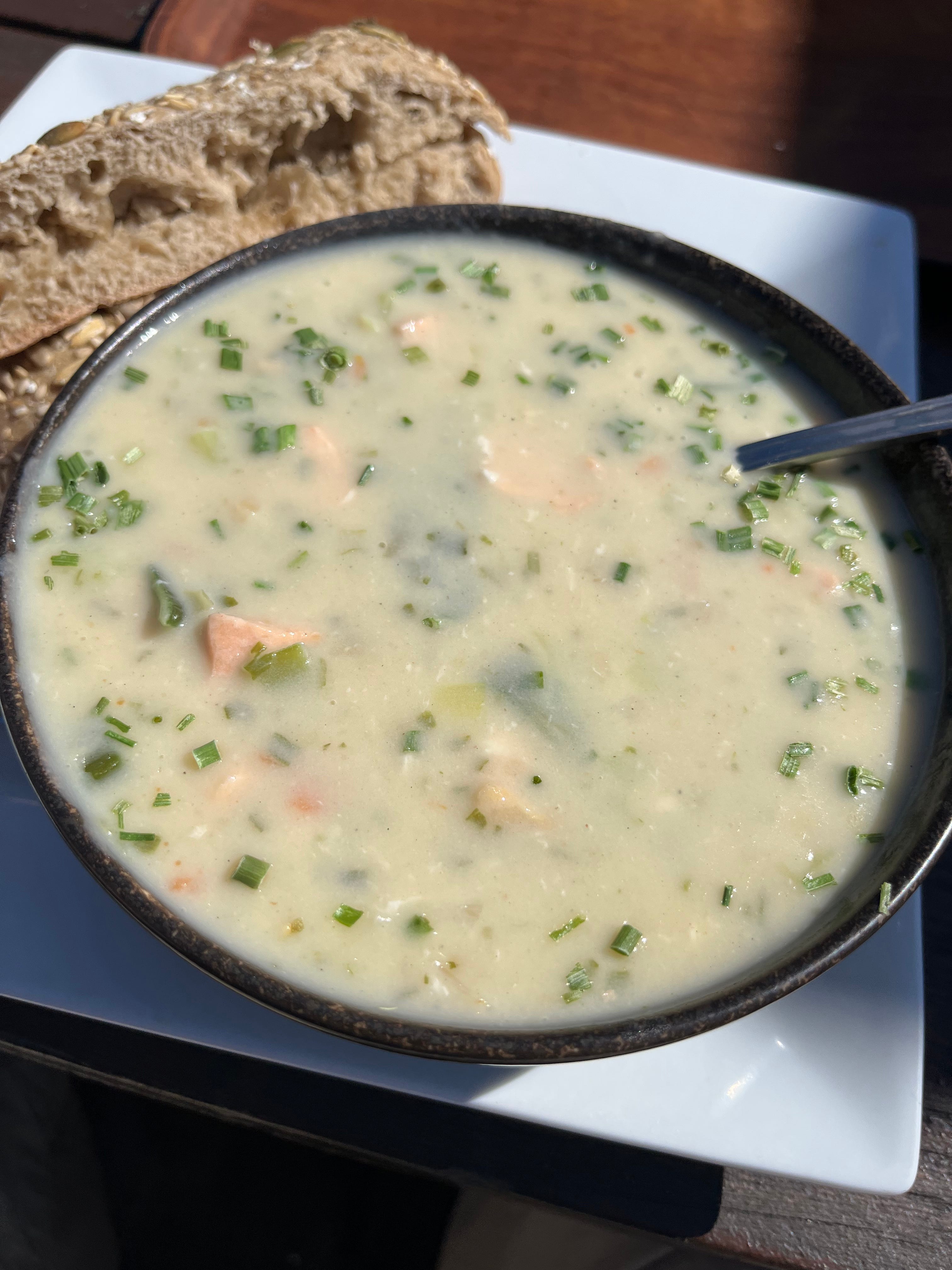
Also, I had fiskesuppe on three different occasions and I can safely say that Norwegian fish soup really is one of my favorite soups!
Forgetting the Holocaust and the Battle for the Soul of Germany

With antisemitism on the rise across Europe, Germany is at an inflection point. Since the end of the second World War, the memory of the Holocaust has been foundational to the country’s identity. But Holocaust survivors, who served as a living testament to the country’s crimes, are almost gone.
One of Germany’s most prominent witnesses to the Holocaust, Margot Friedländer, passed away last year at the age of 103. By 2040, the number of Holocaust survivors will have dropped to just about 21,300, a 90% fall from today, according to an estimate by the Jewish Claims Conference, the organization that distributes German compensation payments to Holocaust survivors.
Additionally, 38.1% of respondents said it was time to “close the book on the era of National Socialism,” according to a study published last year by Bielefeld University. It was the first time since the university began asking the question in 2018 that the group seeking closure outnumbered those with the opposing view.
Antisemitism is on the rise again all over Europe and also in Germany. This really makes me sick. We have to refocus our approach to remember, our so called rememberance culture, and make sure that people understand that the shoa was a singular event in history that cannot be compared to any other cruelty that has happened - and that we have to make it will never happen again! Anyone who has ever talked or listened to a witness of the shoa cannot forget this and needs to pass it on. I will never forget the old lady who talked about what it was like to be one of the so called “Mengele Twins”, how she was held in a cage for experiments and how her twin sister died after an injection. She was four years old. Never again!
Why is it so hard for the U.S. to win wars?

The U.S. has been at war for more than 20 of the past 25 years in three major conflicts all in the same region. First, Afghanistan, then Iraq, now Iran.
U.S. presidents said overwhelming American miliary firepower would decide all these wars swiftly. Under President George W. Bush, the U.S. military needed just weeks to oust the Taliban in Afghanistan in 2001 and President Saddam Hussein in Iraq in 2003. Under President Trump, the U.S. bombing campaign, assisted by Israel, killed many of Iran’s leaders on the first day of the war and hammered the country at will.
Yet time and again, raw military might has not translated into clear political success and the kind of fundamental change the U.S. has sought. Today, the Taliban are running Afghanistan. Iraq has achieved a measure of stability, but still struggles on many fronts after a long, brutal war. Iran’s theocratic regime remains in place, the war still unresolved.
Why is the U.S. finding it so hard to win wars?
That is a fantastic question. Also, Russia is not doing much better these days.
One explanation I would like to add: the hope for a self-fulfilling prophecy is not the best strategy for winning a war. A broad coalition against Iran and its proxies to bring peace to the Middle East (and its shipping routes) is more necessary than every, but that means diplomacy and reaching out to countries that might have different opinions and objectives. The current US administration is not capable of doing this and the self-declared war secretary cannot tie his shoelaces alone let alone pick socks and tie that don’t make him look even more stupid than he actually is.
The Anti-Sunscreen Movement Is Coming for You

Sunscreen, for all its cancer-preventing, antiaging power, is facing a massive PR crisis. Not since the Jersey Shore guys replaced SPF with GTL (that’s “gym, tan, laundry”) has UV protection been viewed as so wrong and sunbaked bronze as so right. Interest in tanning and sun-related content is once again spiking on Instagram (up 10 percent from 2024 to 2025) and TikTok (a 20 percent increase, also from 2024 to 2025). The #antisunscreen hashtag has clocked more than 5 million views while #nosunscreen is up to 11 million and counting. A 2024 survey conducted by the Orlando Health Cancer Institute found that one in seven adults under the age of 35 now believes that daily sunscreen use is more harmful to skin than direct sun exposure, and in the 2026 edition of the American Academy of Dermatology’s annual Practice Safe Sun Survey, 16 million adults reported reducing or stopping sunscreen use because of online claims about its safety.
That is so insane. Seriously, how can anyone believe this crap? And since when can Men’s Health publish long articles and not once mention a six-pack? Also, just for the record: we have far superior sun screen here in Europe and the article gets all the facts about sun screen right - it sounds exactly like what my wife told me about sun screen and I pay attention to her before buying or applying sun screen. Still, I did manage to get sunburned in Norway…
Uncovering a global ancient history beyond Greece and Rome

The de facto equation of ‘ancient history’ with ancient Mediterranean history, at least in most of the Anglosphere, has endured for many generations. But we are on the cusp of a dramatic shift in perspective that is producing a much bigger, broader and more exciting view of ‘the ancient world’.
Part of what is driving this expansion in perspective is an accumulation of evidence hinting at connections between the ancient Mediterranean and distant regions in Afro-Eurasia. We now know, for example, that trans-Saharan trade can be traced back to the first two centuries CE, at the height of the Roman Empire, when Roman products such as wine, olive oil and silver were exchanged – largely through merchants operating in the southwestern Libyan desert – for gemstones, ivory and slaves. Hoards of Roman coins have been found well beyond the frontiers of the empire, from Scandinavia to India. A papyrus from Egypt in the middle of the 2nd century CE records the details of two contracts for the import of various goods from India, including pepper, pearls, silk and gemstones, shipped to Alexandria from the port of Muziris in Kerala, southwest India. What all of this implies is a far-flung web of transimperial commercial contacts in the first few centuries CE.
Historians of the ancient Mediterranean are increasingly reckoning with a ‘global antiquity’
Recently I thought about the fact that even though I studied medieval history, I really don’t know anything about the ancient or medieval history outside of Europe and I wondered how region were connected back then and how that influenced the way humanity developed. And just a few weeks later, I stumble across an article that discusses these blind spots and how the perception of history is changing.
‘Cancer Doesn’t Care What Party You Belong To’: Poisoned Water Is Turning This Rural State Bluer

Whether Republican voters are mad enough about the state’s toxic water to vote for a Democrat remains the question that will drive Iowa politics until November.
There are signs that Jones is making inroads, even with some farmers. Three of Iowa’s best-known social media activists are a trio of corn-and-soybean farmers known as the “Lobe Rangers.” The name refers to their home region, a large soil-rich swath of north-central Iowa known to geologists as the Des Moines Lobe. They have gained a reputation in contemporary Iowa politics for speaking candidly about their outrage at the state’s poor water quality, and the refusal by policymakers and their fellow farmers to address it.
They’ve been impressed by Jones’ run. Until he came along, Matthew Bormann, one of the Rangers says, “We’ve never seen a candidate in Iowa — I don’t think we’ve ever seen a candidate, period — who’s led on water quality.”
So there is hope that Iowa swings back from MAGA to a somewhat saner state. That’s a good sign, but it would be even better if it didn’t have to get so bad in the first place…
That’s it. Have a great Sunday! If you missed last Sunday’s edition of Five Things, have a look here:

— Nico
Summer vacation without a (little/minor) sunburn is no summer vacation for a male Gen X person…