

Hello and welcome back to Five Things!
The World Cup has started. I am trying to get into the right mood for it, but I probably won’t stay up late to watch games at midnight or very early in the morning. I did buy two flags and put them on my car - one of the rare occasions when ordinary Germans display the national flag.
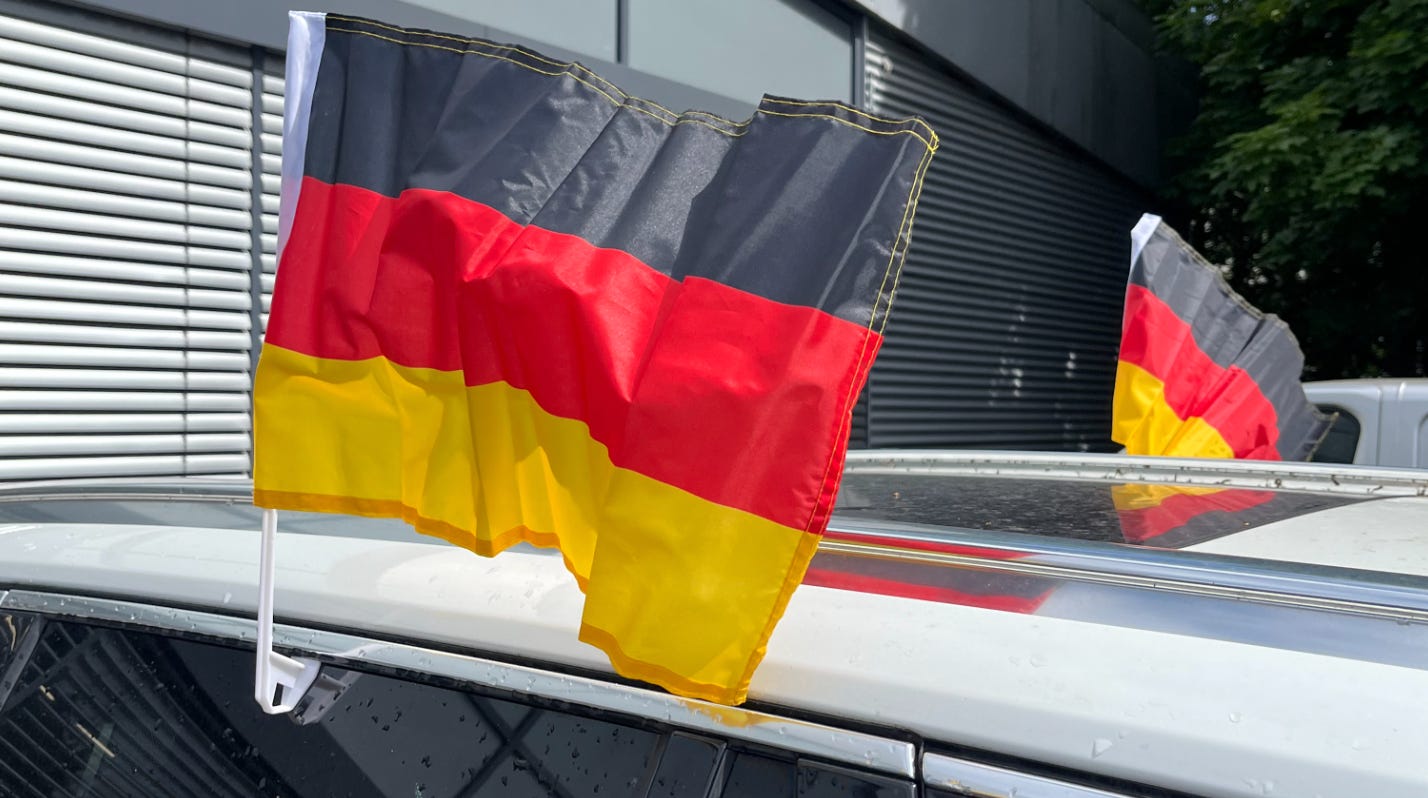
Obviously, I hope that Gary Lineker is right again: “Soccer is a simple game: twenty-two men chase a ball for 90 minutes and at the end, the Germans always win.” - and if we don’t, it will be akin to a national crisis, further deteriorating the collective mood our our nation.
The U.S. Is the Future of Soccer, for Better or Worse

It is a moment to take stock of the altered landscape. For decades, soccer posed a riddle of American exceptionalism. What would it take for the world’s most powerful country to get on board with humanity’s favorite sport? The change, it turns out, came slowly, and then with shocking speed, transforming the United States not just into a bona fide soccer nation, but a novel and unusually influential one. It’s a story that holds a heady plot twist: For better and — more to the point, perhaps — for worse, Americans may not have joined soccer’s universe so much as soccer has embraced America’s.
I beg to differ and I’ll do it with this German sayings:
Geld alleine schießt keine Tore - money alone doesn’t score goals.
And while we are at it, I think it is hard to replicate a century of football tradition and folklore in just a few decades, this has to grow. And the best quotes have are already been coined by people like the legendary German National Coach Sepp Herberger, who famously said:
“Das Spiel dauert 90 Minuten.” - “The game lasts 90 minutes.”
“Nach dem Spiel ist vor dem Spiel.” - “After the game is before the game.”
“Der Ball ist rund.” - “The ball is round.”
“Das nächste Spiel ist immer das schwerste.” - “The next game is always the toughest.”
“Die Leute gehen ins Stadion, weil sie nicht wissen, wie es ausgeht.” - “The people are going into the stadium, because they don’t know how it is going to end.”
Try to beat that! Football philosophy is something Germans have excelled at for years!
Amazon CEO’s Talks With U.S. Officials Triggered Crackdown on Anthropic Models

The government’s talks with Amazon—a big investor in Anthropic that supplies the AI company with chips for data centers, while deploying its best models to identify software vulnerabilities—are a sign of how America’s largest companies and governments are navigating the emerging technology’s novel capabilities. Friday’s rapid events show how quickly new discoveries and experimentation can affect government restrictions and, potentially, company fortunes.
The German saying “Eine Krähe hackt der anderen kein Auge aus” - “One crow doesn’t peck another’s eye” clearly does not apply here. Also, from a European perspective it is clear that we need to increase our efforts, otherwise we could be left with less powerful LLMs.
At Delaney Hall, a V-Neck Sweater Can Change a Life

I first visited Delaney Hall with my husband and two daughters in August 2025. A parent from my local Facebook page was looking for someone to pick up and deliver pantry bags there. This was the perfect opportunity for me to visit a site I’d been eager to protest since its reopening in May 2025 but had been too intimidated to visit: What if I’m just in the way? What if there are a lot of cops? What if ICE is there? If Newark mayor Ras Baraka could be arrested, it must mean anyone can be arrested. It took me only a couple of visits to Delaney Hall to realize I needed to expand my definition of activism. In my mind, I had equated the term to loud protesters, megaphones, signs, gas masks, and of course phones for documentation purposes. This type of protest is necessary for political change; it brings visibility to a cause. In most cases, though, it doesn’t provide logistical steps to realize meaningful movement.
The Trump regime just disgusts me.
Donald Trump’s Pallets of Cash

The joint U.S.-Israel campaign destroyed physical things that can’t be easily replaced, like nuclear facilities. Entering negotiations with Iran to secure physical things that yet remain—the remainder of the regime’s nuclear facilities and its stockpiled enriched uranium—is an acknowledgment that you are, at least at present, not capable of or willing to destroy or seize them. Shifting from war to talks tilts the balance of power in the other direction, away from the U.S., which at war made no concessions, and toward Iran, to which Trump must now make concessions to make a deal.
While I still think that we have to make sure that the Mullahs do not get nuclear weapons, I really do not understand how the USA and Israel could have missed the importance of the Strait of Hormuz. This gave Iran leverage and it was totally unnecessary.
The Strange Defeat of Nuclear Deterrence

Nuclear weapons can appear impotent in the face of sustained conventional and hybrid attacks; in today’s warfare, an arsenal of nuclear-tipped intercontinental ballistic missiles, a flotilla of nuclear submarines, and squadrons of strategic bombers can do little to deter salvos of cheap drones—as long as those nuclear states remain unwilling to use their weapons. That should give pause to both existing nuclear powers and those that may want to acquire the weapons.
The Ukrainians have been showing us for years how to deal with the lingering threat of nuclear weapons. While the Europeans were still debating how to help without poking the Russian bear, Ukraine just fought back and continues to do what it can to show that Russia will never win this war.
If you haven’t already, please drop everything and subscribe to Five Things now!
That’s it. Have a great Sunday! If you missed last Sunday’s edition of Five Things, have a look here:

— Nico