

Hello and welcome back to Five Things!
I am one of the luckiest guys in the world. A few years ago I was grumpy and needed a change of scenery, so my mother suggested I’d spend a year abroad in the USA. Through sheer luck and coincidence I ended up with a family in Des Moines, Iowa. At first, I was kind of intimidated: big house on a hill, huge frontyard, mother in a business dress, father in a suit and tie, four kids. I was concerned how I could fit in.
30 Minutes later, I felt like I was part of the family. 36 years later, I am happy as a clam to have my American parents at my house in Hamburg. We have grown so close across the distance over the years and when I left Des Moines in 1990 I cried on the plane all the way to the next stop because I feared I’d never see them again. Meanwhile, I have a family with four kids of my own, I do not often wear a suit and a tie, but plenty of L.L. Bean Dadcore and I am so grateful that this family let me into their home and hearts in 1989. Whenever we meet, it feels as if we had just seen each other last week. My kids love their American grandparents and all the family they have across the pond. It is really the greatest gift of all and I do feel less grumpy than I did in 1989. Ok, I did miss the East German border coming down 10 km away from where I grew up in Germany, but this is so worth it! Love you lots, Jeanie and Bill!
Enjoy these Five Things!
Finland Is Ready for Russia. Is Anyone Else?

With Russia rampant, and Trump treating the once-solid US commitment to its greatest alliance as a bargaining chip, Europe’s leaders and militaries should look to a country that long assumed it would have to defend itself and organized its society around that possibility. The trillion-dollar cost of making Europe ready for Russia, and less reliant on the US, is actually the easy bit.
The far harder task is to develop the cultural and institutional sinews that Finland has built over many decades. Conscription and extensive civil defense shelters, now historical curios in much of the West, remain bedrock elements of Finnish defense. “Go to a bar and shout, ‘Who can shoot an anti-tank weapon?’ All the men will stand up,” says Oskari Jaakkola, chief executive officer of Finnish battery startup Cactos and an army reservist with the rank of lieutenant. Finnish companies, meanwhile, form an organized industrial reserve of their own. Even preschoolers there are taught to spot the online disinformation that characterizes 21st-century hybrid warfare. For the sake of its own security, and that of the wider Arctic, Finland needs its allies to learn these lessons quickly.
I am a big fan of Finland and I am glad they finally joined NATO. The Finns are very realistic about Russia and also very determined not to get attacked every again by Russia. Also, they have saunas and take off their shoes when entering an office. What’s not to like?
You Could Be Next

There is an underlying tension between the predictions of generally intelligent systems that can replace much of human cognitive labor and the money AI labs are actually spending on data to automate one task at a time. It is the difference between a future of abrupt mass unemployment and something more subtle but potentially just as disruptive: a future in which a growing number of people find work teaching AI to do the work they once did. The first wave of these workers consists of software engineers, graphic designers, writers, and other professionals in fields where the new training techniques are proving effective. They find themselves in a surreal situation, competing for precarious gigs pantomiming the careers they’d hoped to have.
This is a really alarming piece, but currently I do not buy into this. Sure, people lose their jobs or their jobs get re-interpreted differently and this sucks for the individual, but I do not see currently that knowledge workers get replaced left and right.
I make good money. Why do I still feel like this?
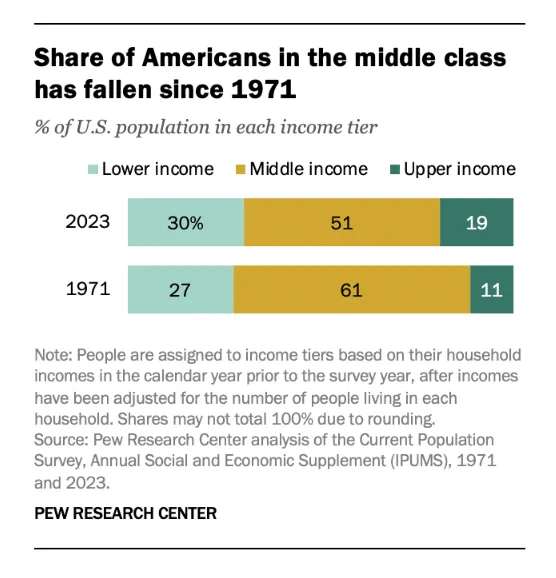
America got a policy-backed bundle of stability that, for millions of families, functioned as middle-class life. And then, piece by piece, it was disassembled.
Following came an era of deregulation, the decline of organized labor, the financialization of everything from housing to healthcare, tax policy that increasingly favored capital over wages, and a bipartisan consensus that “the market” would deliver what policy used to guarantee. Pensions became 401(k)s — shifting risk onto individuals. Union membership cratered. Public university tuition exploded. Healthcare became something that could bankrupt you. Home prices are up 60% since 2019 alone. Childcare in 45 states now costs more than the mortgage.
This is not just an American phenomenon, we can see this pattern in Germany, too. And yet people vote for conservative and neo-liberal parties. And they vote for the far-right parties as if they’d change anything. They never will and never cared to begin with.
Indie coffee shops are meant to counter corporate behemoths like Starbucks – so why do they all look the same?

In other words, independent coffee shops in North America have become so similar aesthetically that their location cannot be picked from a lineup. The purportedly unique and local feel of coffee shops has instead been homogenized into a singular, palatable, North American aesthetic.
Ironically, these shops have narrowed their aesthetics like a de facto brand franchise – exactly like the chain stores that their patrons ostensibly reject.
This conformity is really weird, as if they all went to the same barista class and ordered everything from the same online shop. Also, I think I am done with pretentious coffee places, maybe someone should open a place with standing room only and just filter coffee from a thermos served in plastic cups?
Sense of Scents

You can fake an accent, buy a pair of cowboy boots, adopt a football team, feign a favorite taco truck, appropriate “y’all,” and complain about Californians—while stepping in front of your own license plate. But the allergic reaction to cedar pollen is both involuntary and impossible to simulate. The only thing up to you is how much you complain.
A native, or someone who’s been here a season longer than you, will tell you the two irritating truths about cedar fever: The trees we call cedars are Ashe junipers, and their pollen rarely causes a genuine fever. But the specificity of the plague is genuine. This is not the illusion of possession, like breakfast tacos or cowboys. A map of the trees’ density distribution shows a dark green bubble that starts slightly east of Austin and goes west into the heart of the Hill Country, extending north just short of Dallas and south past San Antonio. Satellites drift over the rest of the state. The trees exist in other states. They smother Central Texas.
I do miss Austin, Texas, I really do. I haven’t been at SXSW in a while, but I have gotten to know the town a bit and really liked it and the buzzing atmosphere during SXSW.
That’s it. Have a great Sunday! If you missed last Sunday’s edition of Five Things, have a look here:

— Nico