

Heya and welcome back to Five Things AI!
This week is a reality check. The agents write the code now, but the hard part just moved downstream to the humans who have to review it, hold the context, and catch the mistakes nobody saw coming. Meanwhile the studies keep landing: lots of output, plenty of slop, and surprisingly little ROI or GDP to show for it. Cohere drops a 30B coding agent that runs on a single H100, which is exactly the kind of thing that finally lets plenty of rather hesitant companies do agentic coding without sending its code to the cloud. Meta tries to sell subscriptions to a corporate market that has never wanted to buy from it. And Ramp reveals that the median firm spends 11 USD a month on AI while a tiny top tier spends 7,449 USD per employee. Five stories, one question underneath all of them: who is actually getting value here, and who is just spending?
Agentic AI solved coding — and exposed every other problem in software engineering

As AI-generated code scales, human review is becoming a massive new bottleneck, and engineers are losing the context needed to catch agent mistakes. The companies that understand this will move forward deliberately and even create new roles because of AI. The ones that don’t will default to a simpler, far more destructive conclusion: Reduce headcount and increase AI spend.
I don’t think human reviews are the answer. Agentic peer-reviews will be the norm pretty soon.
Slop, productivity, and why the AI-fueled world is going nowhere mighty fast
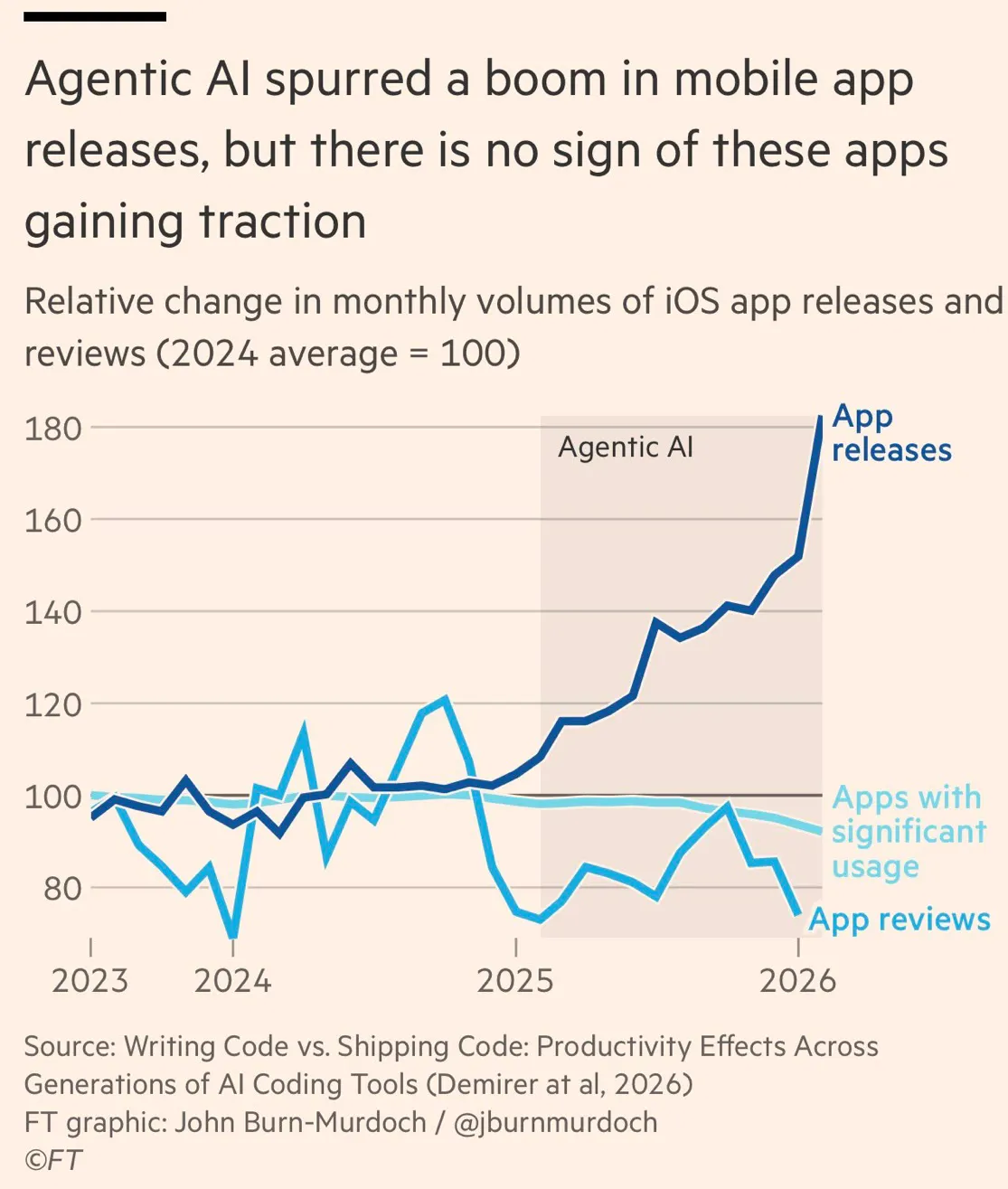
AI generates a lot of output (which fits many people’s informal notion of productivity), but it hasn’t yielded much in the way of RoI for many companies (per studies from MIT, McKinsey, Bain, and many others), and hasn’t materially changed GDP.
Actually, while I do see the issue of AI slop in a lot of places, including software development, I do see a trend for Personal Software on Demand. I can just build a tool for myself or my company and I do not expect any more than just a handful of people to use it. That is a true paradigm change.
Cohere Open-Sources North Mini Code: A 30B Coding Agent That Runs on a Single H100

Cohere’s North Mini Code landed on June 9, 2026, with a straightforward pitch to developers: a 30 billion parameter agentic coding agent, Apache 2.0 licensed, that fits on a single NVIDIA H100. Independent testing by Artificial Analysis ranks it 8th of 127 comparable open-weight models on output speed at 210 tokens per second, with a time to first token of 0.25 seconds against a class median of 1.95 seconds. The catch — and it’s a real one — is verbosity: the model generated 75 million output tokens in Artificial Analysis benchmarking against a class median of 25 million. That’s three times the output of comparable models. For developers deciding whether to route agentic coding workloads through a managed API or a self-hosted open-source model, this is the clearest open-source contender to emerge in 2026.
I had a conversation a few weeks ago with the father of one of my youngest daughter’s friend and he told me that while he is really interested in agentic coding, he cannot do it in the office. He works at a large insurance company and code getting created with the help of an LLM outside the company is just out of the question. I am really interested how the development of the agentic coding LLMs will advance in the next few months. Public institutions will take note, hopefully.
Meta’s Subscription Push Exposes Its Weak Hand in AI

Meta’s bid for corporate AI customers is even more far-fetched, with competitors including Google and Microsoft entrenched. Meta says it already has a million companies using its corporate AI agent, for which it eventually plans to charge a subscription fee.
But companies have never been core customers for Meta outside ad sales, and its commitment to them has wavered over the years. It discontinued VR headsets geared toward companies earlier this year as its priorities shifted.
Meta has used AI more effectively than pretty much anyone else to improve the performance of ads, and its revenue is expected to grow quickly because of that. Analysts expect around $60 billion of revenue in the second quarter, according to FactSet, a 27% increase from the prior-year period.
Here’s a thought: how about Meta would use AI to improve the user experience, finally moderate all those spam accounts everywhere and filter out all the AI slop?
How much does it cost to be AI-pilled?

The top 1% of firms spend $7.45K per employee per month. The top 10% spend $611 per employee per month. The median firm spends just $11.38 – about the cost of a seat on an enterprise ChatGPT or Claude subscription.
And while several high-profile proclamations have said you should be spending as much on AI as you do on a software engineer’s salary…no one is actually doing that. For the top 1% of spenders, per employee AI spend is still less than half the typical monthly salary for an engineer. Not to say that won’t change – AI spend is still rising – but very few firms, if any, are actually doing that.
That is insane. I am spending a lot less, probably around 250€ and that is still more than plenty…
