

Hello and welcome back to Five Things!
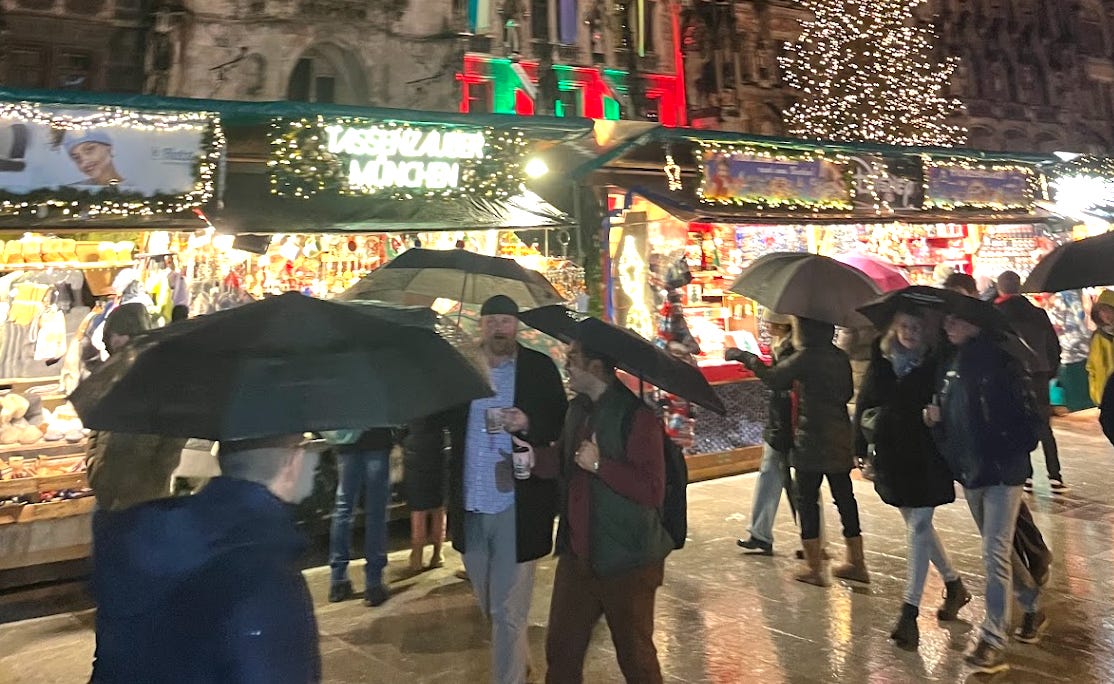
Today is the second Advent Sunday, so slowly everything turns christmassy here in Germany. There is a Christmas market at virtually every corner where they serve Bratwurst and mulled wine. Nothing screams Christmas like drinking mulled wine in the rain while people continue bumping into you. Nope, I’m not a Christmas Grinch, but what used to be special is now more than overcommercialized and virtually everywhere. For me, this whole Christmas thing is tied to snow and unless it is really cold, I have a hard time getting into the Christmas spirit. Also, as usual, stuffing 4 weeks of work into 2 1/2 weeks leads to loads of work, which makes it harder to get into a festive mood. Anyhow, we went to a large grocery store and bought the brand new butter with cinnamon and sugar, which all the influencers talked about on Instagram, so I assume everything will now magically fall in its place.
Here are this Sunday’s Five Things - enjoy!
I love AI. Why doesn’t everyone?

The difference between our views of old and new technologies isn’t necessarily irrational. Old technologies present less risk — we basically know what effect they’ll have on society as a whole, and on our own personal economic opportunities. New technologies are disruptive in ways we can’t predict, and it makes sense to be worried about that risk that we might personally end up on the losing end of the upcoming social and economic changes.
But that still doesn’t explain changes in our attitudes toward technology over time. Americans largely embraced the internet, the computer, the TV, air travel, the automobile, and industrial automation. And risk doesn’t explain all of the differences in attitudes among countries.
I love AI. Finally, I can explain math problems to my kids. Also, I discuss lots of business related stuff with Google Gemini 3, which works so well and is such a time-saver - and also gives me new perspectives which I would have missed otherwise. I’m really bullish about Agentic AI, which is really fascinating stuff and I love working with Agents. Also, I am back to coding, which I haven’t really done for the last two decades, but now I let the machine code and just observe what it is doing. So cool. And I am getting stuff done that I would never have been able to code by myself.
The New German War Machine

Germany eventually embraced its own relative powerlessness as a symbol of atonement, and of human progress. After the Cold War, the country’s pacifism became a mark of its faith in a global system of rules and treaties. Germany, the thinking went, could relinquish its own self-defense because brutish competition for continental dominance was over.
[…]
In the decades since World War II, Germans have developed a deep aversion to anything that resembles the Nazi veneration of the soldier. They’ve been outraged by recent scandals that seem to reflect the Third Reich’s lasting imprint on some corners of the military. In the special forces, a sergeant major placed under investigation in 2017 was alleged to have stockpiled stolen ammunition and explosives alongside Nazi memorabilia; at a party, soldiers were said to have performed the Nazi salute, which is banned in Germany. One special-forces unit was so rife with right-wing fanaticism that the defense ministry disbanded it in 2020. Today, screening for extremism is a Bundeswehr priority.
Chancellor Olaf Scholz talked about the “Zeitenwende” and we are really at the turn of an era. Germans don’t understand war anymore, which is a fantastic thing, given our history, but now that we have to focus on rearmament, it is not really helping.
I Work For an Evil Company, but Outside Work, I’m Actually a Really Good Person

Mathematically, it might seem like I spend a disproportionate amount of my time making the world a significantly less safe and less empathetic place, but are you counting all the hours I spend sleeping? You should. And when you do, you’ll find that my ratio of evil hours to not evil hours is much more even, numerically.
I just don’t think working at an evil company should define me. I’ve only worked here for seven years. What about the twenty-five years before, when I didn’t work here? In fact, I wasn’t working at all for the first eighteen years of my life. And for some of those early years, I didn’t even have object permanence, which is oddly similar to the sociopathic detachment with which I now think about other humans.
When I was still in advertising, I sometimes I had to work for a client that we just referred to as “cigarette”. I despised that. Especially because they all smoked during workshops and meetings. But I couldn’t work for an evil company full time. Could you?
They Were Supposed to Save Europe. Instead, They’re Condemning It to Horrors.

Worse may be still to come. In Europe’s leading economies, centrist governments are failing badly. In France, President Emmanuel Macron’s administration is in free fall as Marine Le Pen’s National Rally dominates the polls. In Germany, Chancellor Friedrich Merz seems unable to turn voters away from the nativist Alternative for Germany, even though the country’s intelligence service has labeled it an extremist threat. In Britain, Prime Minister Keir Starmer is sinking almost as fast as the anti-migrant Reform U.K. is rising. The stage is set for a far-right sweep.
Merz has the lowest approval ratings ever and it is not really getting better, even though people hoped that he’d restart the economy. Somehow he is not finding the right angle yet, no pun intended, to push back the far-right idiots.
The Great Downzoning

All else being equal, many people prefer neighborhoods built at low densities. Some of the perceived advantages of low density will apply virtually anywhere, like quieter nights, greener streets, more and larger private gardens, and greater scope for social exclusivity. Other attractions are more specific to certain contexts. Where urban pollution is bad, people seek suburbs for cleaner air. Where crime is high, suburbs are often seen as a way of securing greater safety. In eras with high levels of racism and increasing racial diversity, people moved to suburbs to secure racial homogeneity.
Sometimes I ponder what it would be like to live in a house and then I go to these far away places in our city where I need a car and then I realize that I like living in an apartment in a denser urban area.
That’s it. Have a great Sunday! If you missed last Sunday’s edition of Five Things, have a look here:

— Nico