

Heya and welcome back to Five Things AI!
Oh, this is a fun one. We talk about visions here, how AI can benefit the people and not just make investors rich. And about how and why Anthropic CEO Dario Amodei talks about fear. Also, what will happen after the IPO pop? My bet: people will use cheaper open weight models instead of trying to be cutting edge all the time. Since we need more data centers, why not make them smaller and put them everywhere? And finally, let’s look at looped transformer and geek out a bit about LLM architecture and benchmarks.
Read on my dear, or have your agentic assistant recite this for you.
AI for All Americans

So while AI will transform our economy and the world around us, Americans are right to demand that this transformation serve their needs, not just the interests of the already rich and powerful.
Tech leaders have been warning the public about the potential for massive job loss in the next handful of years. Researchers from both OpenAI and Anthropic have resigned in protest, fearing that their employers were failing to manage the existential risk of an AI-driven human extinction event. When the people building this technology say your job, your children’s future, and maybe your life are on the line, they cannot then ask the public to welcome AI on faith.
Obviously, Reid Hoffman has a point here. As a European, I’d love to extend his thought over to my continent - and we need to discuss how we can reap the benefits of AI without getting into an ever dependency of the USA and China, especially in times where we cannot trust our biggest ally anymore.
How Anthropic CEO Dario Amodei’s Writings Help Explain A.I. Fears

Putting words into sentences and sentences into paragraphs is an old-fashioned thing to do, particularly when the topic being explained is a technology so amazing it might as well be magic. But as Anthropic moves ahead with what may be the largest public offering in history as soon as this fall, Dr. Amodei needs to forcefully reassure everyone that everything is on track. He’s losing if he’s not explaining.
His collected essays are a chronicle of Silicon Valley’s constantly shifting methods of selling its own product to a public that is simultaneously enticed and horrified. It’s not an easy task, convincing the world that something is a slam-dunk even though it will make Silicon Valley richer and more powerful while possibly leaving ordinary folks unemployed or — who knows? — dead.
I have to admit that I have a much better feeling about Anthropic working on frontier models that anything backed by Musk or Altman, but at the same time I also think that there is a lot of sugarcoating there to make the IPO pop even bigger.
The next great AI trade is everything that isn’t AI

It’s not the first time investors have bet on a transformative technology to change the world. We have two good historical precedents: railroads and the internet. In both cases, we invested a single-digit % of our GDP into building railroads and telecommunications infrastructure.
While both these technologies ended up changing the world, neither rewarded the long-term investors who funded the buildout. The key being long-term: short-term traders would have made a killing trading the volatility, but the index was more or less in the same place after the hype was over.
This is a fascinating perspective in a time where we understand how heavily subsidized the subscription plans are vs pure token costs, while at the same time the token costs for open weight model are significantly cheaper at almost comparable performance.
The Startup That Built OpenAI’s Biggest Data Center Is Now Making Tiny Ones

Crusoe is unusual among AI infrastructure startups because it isn’t betting on a single way to make money. Many newer AI cloud providers, often referred to as neoclouds, are known primarily for buying expensive chips and renting access to them.
Crusoe makes money at several layers: developing and leasing data centers, renting out the GPUs inside them, or running AI models for customers and charging for the computing output, known as tokens.
This makes a ton of sense, especially in a time when people strongly object to having a huge datacenter nearby. I also assume that with less scale and the prefab concept there are a lot less issues during rollout.
GPT-6 Astra, Looped Transformers, and Hidden Reasoning
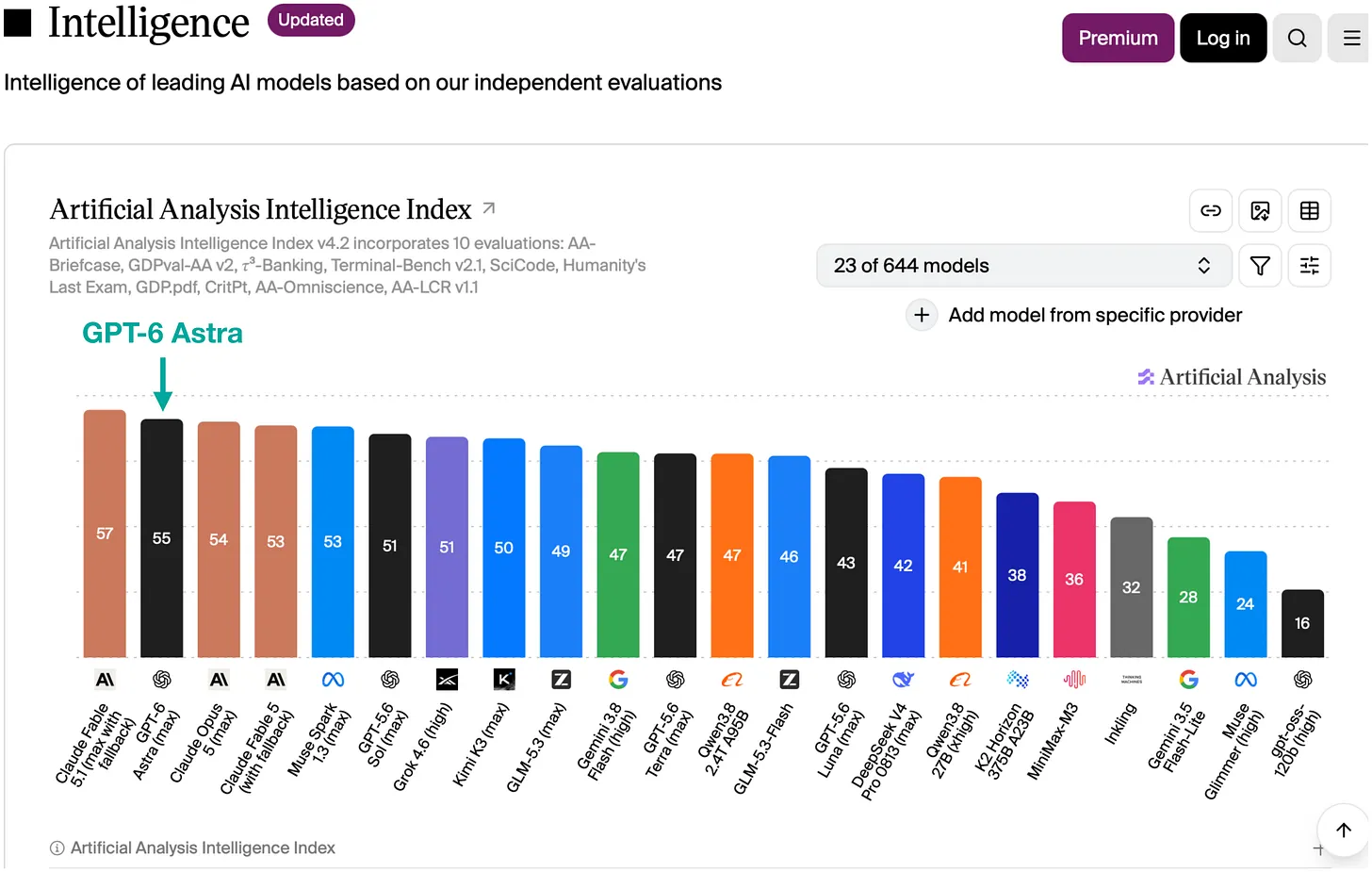
Astra is the best model I’ve used so far, and it’s disproportionately good at 3D rendering and animation tasks (relative to other models). With that, I mean that while it leapfrogs its GPT-5.6 predecessor in practically all categories (writing, math, coding, and more), it especially does so when it comes to graphical demos.
Ok, wow.
And if you ever wanted to know what loop transformers are, dig into this article.
If you missed last week’s edition of Five Things AI, you can read it here:

That’s it for Five Things AI this week! 🤖
— Nico